Quick Guide
- Why It's Biologically Impossible (The Science Bit, Made Simple)
- But What About That Weird Behavior? Understanding What You're Really Seeing
- The Real Question: Can Cats and Rabbits Live Together Safely?
- Debunking the Myths and Answering Your Burning Questions
- Final Thoughts: Focus on Reality, Not Fantasy
Okay, let's just get the big one out of the way right up front. The short, definitive, biological answer is no. A cat and a rabbit cannot breed and produce offspring. They cannot have babies together. The idea of a "cabbit" or a "rabcat" is pure fiction, belonging to the realms of internet myth, cartoons, and wishful thinking. I know, I know, it's a bit disappointing if you were hoping for some magical fluffy hybrid. I've seen those photoshopped images online too, and they can look weirdly convincing at a glance.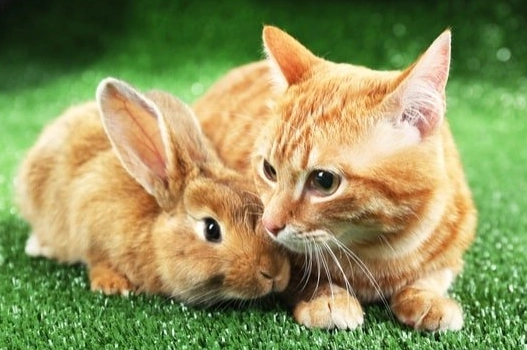
But here's the thing. If you're asking "can a cat and a rabbit breed have" anything to do with each other, you're probably coming at this from a few different angles. Maybe you're just wildly curious about animal biology. Maybe you saw some strange behavior between your pets and got worried. Or, and this is a big one, you're thinking about keeping a cat and a rabbit together and want to understand the entire dynamic, not just the breeding part. That last point is where this gets really important, and where most quick answers online fall short.
The Core Truth: Cats (Felis catus) and rabbits (Oryctolagus cuniculus) are separated by a vast evolutionary gulf. They are different species, different genera, different families even. The biological barriers are absolute and insurmountable.
Why It's Biologically Impossible (The Science Bit, Made Simple)
Let's break down the "why" without getting a PhD in genetics. The reasons are stacked up like a brick wall.
Chromosome Count Mismatch
This is the most fundamental deal-breaker. Every species has a set number of chromosomes, which are like the instruction packets for building an organism. For reproduction to work, these packets need to match up perfectly during cell division.
- Cats have 38 chromosomes. (19 pairs)
- Rabbits have 44 chromosomes. (22 pairs)
Imagine trying to complete a 1000-piece puzzle with a box that has 1156 pieces of a completely different picture. That's the scale of the mismatch. The sperm from one and the egg from the other simply cannot pair up correctly to form a viable embryo. The cellular machinery would fail at the most basic level. So, asking if a cat and rabbit breed can have a viable pregnancy is like asking if a DVD can play in a cassette deck.
Reproductive Isolation & Species Barrier
Evolution has built incredibly specific locks and keys for reproduction. The anatomy, the physiology, the chemical signals—everything is tailored within a species. A cat's reproductive system is designed for other cats. A rabbit's for other rabbits. The mechanics don't fit, literally and figuratively. Even if by some bizarre chance fertilization somehow occurred (it wouldn't), the resulting zygote would be non-viable and the body would reject it immediately.
This is a universal rule across the animal kingdom for animals this distantly related. You might as well ask if a dog and a parrot can breed. The biological gap is similarly huge.
A Quick Comparison Table
Sometimes seeing it side-by-side helps drive the point home.
| Biological Factor | Domestic Cat | Domestic Rabbit | Why It Matters for Breeding |
|---|---|---|---|
| Scientific Classification | Family: Felidae Genus: Felis | Family: Leporidae Genus: Oryctolagus | Different families = massive evolutionary divergence. |
| Chromosome Number | 38 | 44 | Prevents proper chromosomal pairing during meiosis. |
| Gestation Period | Approx. 63-65 days | Approx. 28-31 days | Internal developmental clocks and placental structures are incompatible. |
| Type of Ovulation | Induced ovulator | Spontaneous ovulator | Fundamentally different hormonal triggers for the release of eggs. |
See what I mean? It's not just one thing; it's everything. The entire blueprint is wrong.
But What About That Weird Behavior? Understanding What You're Really Seeing
This is where panic or confusion often sets in for pet owners. You might see your cat mounting your rabbit, or vice-versa. Your immediate thought might jump to "are they trying to... you know?" Let's clear that up.
Mounting behavior in animals is NOT always about reproduction. In fact, most of the time in interspecies situations, it's about something else entirely:
- Dominance and Social Structuring: This is the big one. An animal mounting another is often asserting its place in the hierarchy. It's saying, "I'm in charge here." This is very common, especially during initial introductions or if there's tension.
- Play: Sometimes it can be a clumsy, misplaced part of play behavior, especially in younger animals who are still learning social cues.
- Redirected Behavior: A frustrated or excited animal may mount another as an outlet for energy that has nowhere else to go.
So, if you see this, don't think, "Can a cat and a rabbit breed have this intention?" Instead, think, "Who is trying to be the boss here?" or "Is someone feeling stressed?" It's a communication issue, not a reproductive one. You need to manage the social dynamic, not worry about hybrid babies.
Important: Even if the intent isn't breeding, mounting can be stressful and scary for the animal on the receiving end (usually the rabbit). It should be interrupted calmly and redirected. It's a sign you need to re-evaluate their living situation and interactions.
The Real Question: Can Cats and Rabbits Live Together Safely?
Ah, now we get to the heart of what most searchers actually need to know. You're not really worried about mythical hybrids; you're worried about keeping your actual, living pets safe and happy. Can they be friends? Roommates? Or is it a disaster waiting to happen?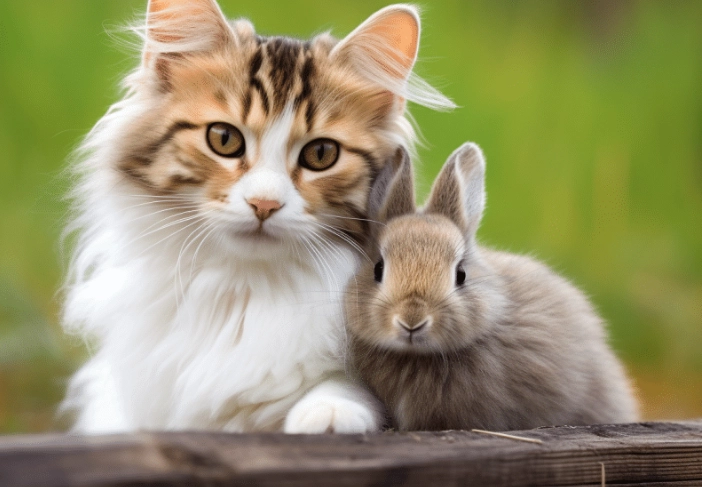
The unsatisfying but accurate answer is: It depends, and it's inherently risky. It's not about breeding; it's about predator and prey wiring.
Cats are obligate carnivores and natural hunters. Rabbits are prey animals. This is hardwired into their brains. A rabbit's instinct when startled is to freeze or flee. That sudden movement can trigger a cat's chase instinct in a microsecond—sometimes even in the gentlest, most well-fed cat. It's not about malice; it's about millennia of instinct kicking in before the "this is my friend" thought can form.
I've spoken to a rabbit rescue volunteer who told me some truly heartbreaking stories. The most common one wasn't outright attack. It was "the cat was just playing" but its play—a paw bat, a pounce—is designed to kill small animals. A single claw to the wrong place can cause a fatal injury to a rabbit, or severe stress that leads to GI stasis (a deadly condition for rabbits). It happens fast, and with no "warning" growl like you might see with dogs. It just takes one moment of triggered instinct.
That said, under extremely controlled and specific circumstances, some cats and rabbits can learn to tolerate each other's presence, and even appear peaceful. But calling them "friends" is often us projecting. The rabbit is often just chronically stressed, which is terrible for its health.
If You Must Try: The Non-Negotiable Rules
If you're determined to attempt cohabitation, understanding that a cat and a rabbit breed cannot have offspring is the least of your concerns. Safety is everything. Here's a blunt list of must-dos.
- Spay and Neuter Both Animals. This is non-negotiable. It reduces hormonal drives, territorial aggression, and makes both animals calmer. The American Veterinary Medical Association (AVMA) stresses the health and behavioral benefits of this for all pets.
- The Rabbit Must Have a 100% Secure, Cat-Proof Sanctuary. This means a large enclosure (like an x-pen or a very large cage) that the cat cannot get into, jump on top of, or reach through. The rabbit needs a place to retreat where it feels absolutely safe. Its food, water, and litter box should be in here.
- Supervision is NOT Casual. "Supervised" time together means you are focused, within arm's reach, and ready to intervene instantly. No phones, no distractions. And these sessions should be short.
- Respect the Rabbit's Language. Learn rabbit body language. Thumping, freezing, flattening ears, trying to hide—these are signs of terror. If you see these, the interaction is over immediately.
- Never Leave Them Alone Together. Ever. Not for a minute, not while you grab the door. The risk is catastrophic injury.
- Consider the Individual Personalities. A very young, skittish kitten raised with a calm adult rabbit might adapt better than an adult hunting cat meeting a new rabbit. But there are no guarantees. An elderly, lethargic cat and a bold, large rabbit breed might have better odds, but I'm still hesitant.
Honestly? After years of reading experiences from experts and owners, my personal view has shifted. The stress and inherent risk to the rabbit are so high that I generally advise against it. The potential payoff of them "being friends" doesn't justify the very real danger and anxiety for the prey animal. It's not fair on the rabbit.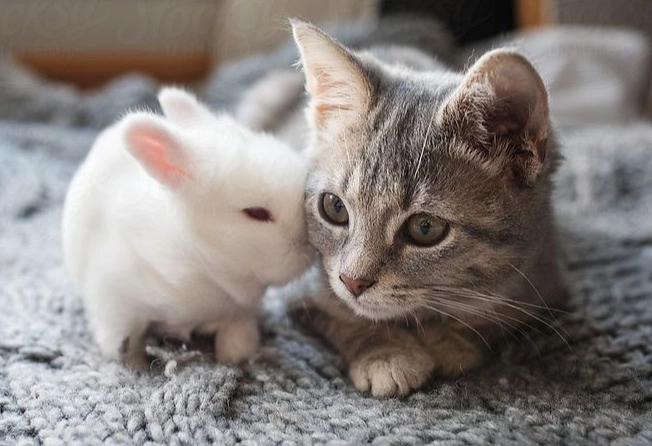
Debunking the Myths and Answering Your Burning Questions
Nope. Those are always one of three things: 1) Clever photoshop. 2) A cat with a genetic mutation (like the Manx cat, which has a shortened or absent tail, giving a rabbit-like silhouette). 3) A rabbit with ear issues (like lop ears that didn't lop properly, standing up in a pointy way). Genetics don't work in a way that would blend features so neatly. You can't get a cat's face with rabbit teeth and ears from a single generation cross—it's biologically incoherent.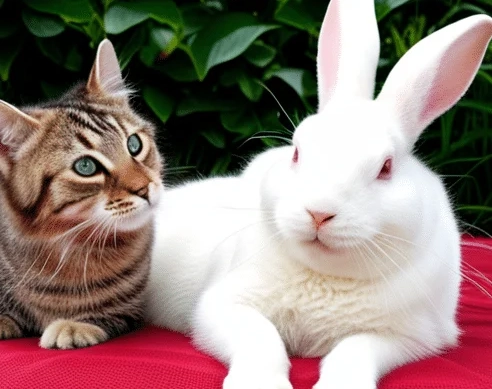
This is a smart question, because mules (horse x donkey) are a classic example of an interspecies hybrid. But the key is genetic closeness. Horses and donkeys share a recent common ancestor, similar numbers of chromosomes (64 vs 62), and are in the same genus. Cats and rabbits are astronomically further apart. The gap is too wide to produce any offspring, sterile or otherwise. The biological machinery fails at the very first step.
As discussed, it's almost certainly a dominance display. Your rabbit might be asserting itself, especially if it's unneutered. It's not a sexual advance in the reproductive sense. However, it's still problematic behavior that can lead to fights and should be managed by separating them and ensuring both are fixed.
This is a critical practical question. While they can't create hybrid babies, they can potentially share some parasites, like certain mites or fleas. More importantly, a cat's bacteria (like from a scratch or bite) can cause severe infection in a rabbit. Also, cats are the primary host for the parasite Toxoplasma gondii. They shed its eggs in their feces. If a rabbit accidentally ingests anything contaminated with infected cat feces, it can contract toxoplasmosis, which is very serious. This is another huge reason for strict separation of living and feeding areas. The House Rabbit Society, a highly respected authority on rabbit care, has extensive information on safe housing and disease prevention.
So, the disease question is arguably more pressing than the breeding myth.
This is the hardest one, because it tugs at our hearts. We see a cat lying next to a rabbit and think "friendship!" Sometimes, it might be peaceful coexistence born of careful habituation. But often, what we interpret as cuddling is the rabbit sitting still out of fear (prey animals freeze), and the cat enjoying a warm, soft resting spot. The rabbit's stress hormones might be through the roof. It's crucial to look at the rabbit's specific body language, not just the peaceful picture. Is it breathing rapidly? Are its eyes wide? Is it tense? That's not contentment.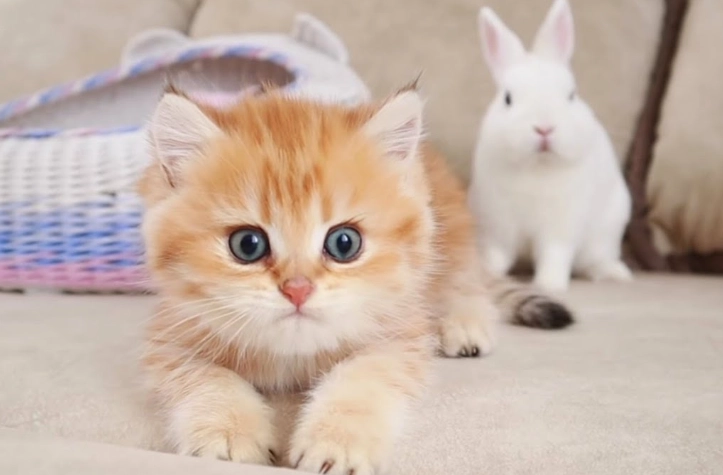
Final Thoughts: Focus on Reality, Not Fantasy
The question "can a cat and a rabbit breed have offspring" has a simple, scientific no. It's a biological impossibility, a genetic dead end. That part is clear-cut.
The much murkier, more important question is about their quality of life and safety together. Here, the answer is fraught with risk. The predator-prey dynamic is not something you can love or train away completely. It's a fundamental lens through which each animal sees the world.
If your goal is to have both a cat and a rabbit, the safest and kindest path is to treat them as separate, beloved pets who live in separate, species-appropriate spaces. Let them have their own safe territories. Their friendship doesn't need to be physical. You can love them both deeply without forcing them into a stressful and potentially dangerous roommate situation.
Invest in a fantastic, enriching set-up for your rabbit where it can binky and dig and be a rabbit without fear. Let your cat have its vertical spaces and hunting-like play with toys. Be the best owner to each of them on their own terms. That's a much more rewarding goal than chasing the internet myth of a cat-rabbit hybrid or a risky interspecies bond.
Remember, responsible pet ownership is about understanding and meeting the innate needs of the animal you've chosen, not about fulfilling our own fantasies of unconventional animal friendships. The truth is almost always more interesting—and certainly more responsible—than the myth.
Reader Comments