Quick Navigation
- The Science: Why "Cabbit" Genetics Don't Add Up
- If It's Not Real, What Am I Actually Looking At?
- Beyond Cats: Animals That Fuel the Hybrid Fantasy
- So You Want a Pet That *Looks* Like a Cat-Rabbit Hybrid?
- Your Burning Questions Answered (FAQ)
- Wrapping It Up: The Final Verdict on the Cat/ Rabbit Hybrid
You've probably seen them. Those adorable, slightly bizarre videos and pictures online: a creature with the fluffy ears and hindquarters of a rabbit, but the face, whiskers, and sometimes the attitude of a cat. The internet calls them "cabbits." Your friends might have shared a post asking, "Is this real?!" And if you're here, you're looking for a straight answer, not just more clickbait.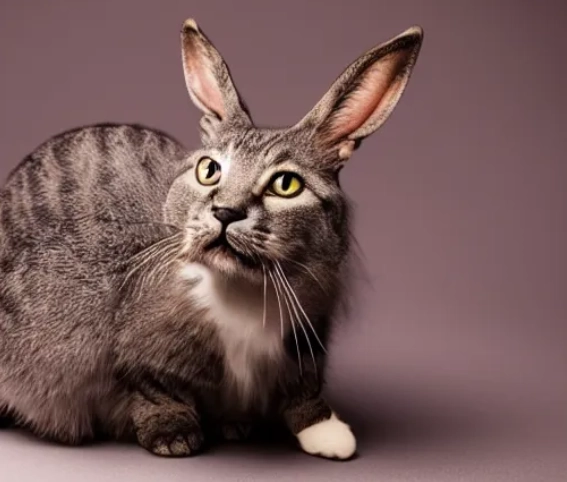
So, let's cut to the chase.
But if the cat/rabbit hybrid isn't real, why does this myth persist with such force? Why do some pets look so convincingly like a mix? That's where the story gets much more interesting than a simple "yes" or "no." It's a perfect storm of internet culture, pet owner love, and some genuinely unusual-looking animals.
We're going to dig into all of it.
The Science: Why "Cabbit" Genetics Don't Add Up
Let's talk about why the core premise of a cat/rabbit hybrid being real falls apart under basic scrutiny. It's not just that they're different species; it's that they're as different as, well, cats and rabbits.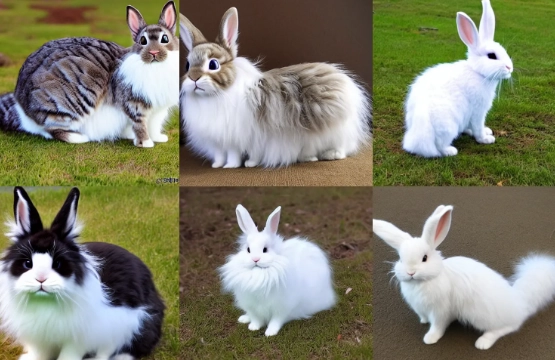
Think of it like trying to plug a USB cable into an electrical outlet. The shapes don't match, the signals are different, and nothing's going to happen. Biological reproduction works in a similarly specific way.
Here’s the breakdown that makes a hybrid impossible:
- Genetic Chasm: Cats have 38 chromosomes. Rabbits have 44. For viable offspring, chromosomes need to pair up correctly during cell division. This mismatch is a fundamental barrier. It’s like trying to complete a 1000-piece puzzle with 800 pieces from one box and 200 from a completely different picture.
- Taxonomic Divide: This is the big one. Cats are in the order Carnivora, family Felidae. Rabbits are in the order Lagomorpha, family Leporidae. Orders are a massive classification tier. Dogs and cats, both Carnivora, can't interbreed. The gap between Carnivora and Lagomorpha is orders of magnitude wider. The National Center for Biotechnology Information (NCBI) taxonomy database clearly places these species in their separate, distant branches of the tree of life.
- Reproductive Incompatibility: Beyond genetics, the mechanics don't work. Their gestation periods, reproductive cycles, and even the basic physiology of mating are entirely different. The sperm of one species would not be able to recognize or fertilize the egg of the other.
- Developmental Roadblocks: Even if, against all odds, fertilization occurred, the resulting embryo would have no genetic blueprint to develop. The instructions for building a cat and building a rabbit are written in two entirely different languages.
So, anyone claiming to have bred a genuine cat/rabbit hybrid is either misinformed about their pet's origins or is not being truthful. The science is unequivocal on this point.
Fact: A veterinarian would be the first person to explain the biological impossibility. They might use the term "cabbit" colloquially to describe a cat's unusual appearance that reminds them of a rabbit, but no certified vet would claim it's a true hybrid. The American Veterinary Medical Association (AVMA) provides resources on pet care and genetics that reinforce the species boundaries we're discussing.
If It's Not Real, What Am I Actually Looking At?
This is the heart of the matter. The myth of the cat/rabbit hybrid being real persists because several very real, and often adorable, phenomena perfectly mimic the look. People aren't just making it up; they're interpreting genuine physical traits through the lens of a catchy internet story.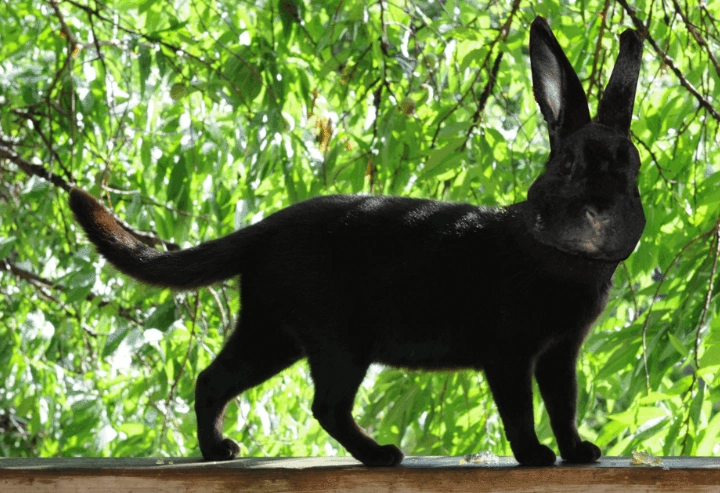
Here are the actual explanations for "cabbit" sightings:
1. The Manx Cat and Other Tailless Breeds
This is the number one culprit, and for good reason. The Manx cat, originating from the Isle of Man, has a genetic mutation that affects the development of its tail. This results in a range from a small "stub" to a complete absence of a tail, known as "rumpy."
A rumpy Manx has a pronounced, rounded hindquarter. When it hops (which some do, due to potential spinal issues linked to the same gene), the visual is uncanny: a cat with a rabbit-like rear and a hopping gait. I once catsat for a friend's Manx, and I'll admit, the first time I saw it scurry across the room, the word "cabbit" did pop into my head. It's a powerful visual.
Other breeds like the American Bobtail or Japanese Bobtail can also produce this tailless or short-tailed look that alters their silhouette.
2. Specific Fur Patterns and Body Types
Some cats just have the right combination of features to trigger our pattern recognition.
- Ear Tufts: Breeds like the Maine Coon or Norwegian Forest Cat have prominent lynx-like tufts on their ears. From certain angles, these can look elongated and bunny-like, especially on a kitten.
- Body Structure: A compact, muscular cat with a dense coat and a less prominent tail can have a rounded shape that suggests a rabbit's body.
- Coat Color: Agouti fur patterns (where each hair has bands of color) are common in rabbits and also appear in some cat breeds like the Abyssinian. This similar ticked fur can add to the illusion.
3. Camera Angles, Selective Breeding, and Photoshop
Let's not underestimate the power of the internet.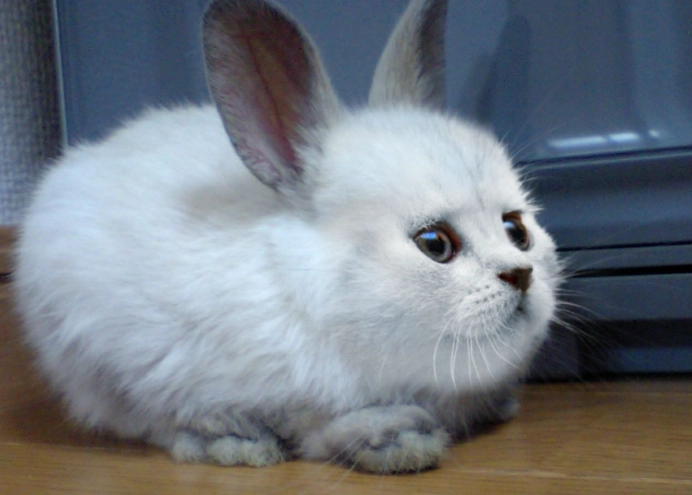
A low-angle shot of a fluffy cat sitting with its hind legs tucked can completely hide its tail and exaggerate its rear. Selective breeding for extreme features (like very short legs in Munchkin cats combined with a lack of tail) can create novel looks that breeders might whimsically—and misleadingly—label. And of course, digital editing can create any animal hybrid imaginable.
So, when you search for "cat/rabbit hybrid is it real," you're often seeing these three factors combined: a genetically unique cat, photographed from a clever angle, shared with a mythical story attached.
Beyond Cats: Animals That Fuel the Hybrid Fantasy
The desire to see fantastical hybrids isn't limited to cats and rabbits. Our brains are wired to connect dots, sometimes where there aren't any. Here are other common "hybrid" myths that follow the same pattern as the cat-rabbit hybrid question: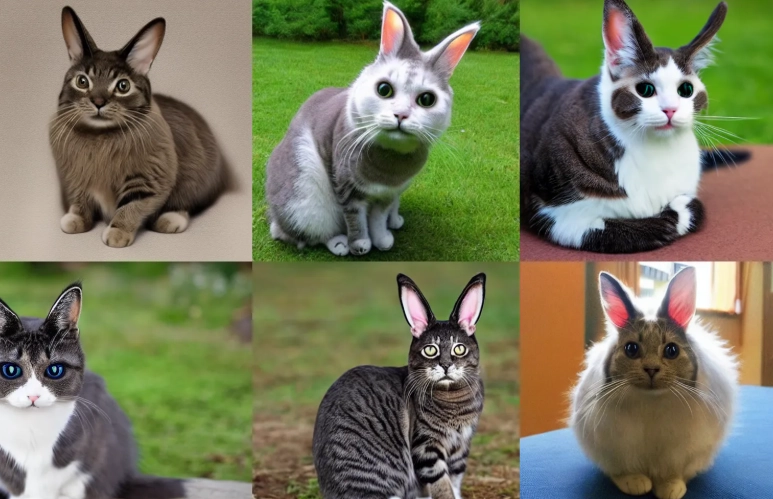
| Alleged Hybrid | Common Name | Reality Check | Likely Inspiration |
|---|---|---|---|
| Dog + Raccoon | "Coyote" or made-up names | Biologically impossible (different families: Canidae vs. Procyonidae). | Tanuki (Japanese raccoon dog), which is a real canid species, or dogs with raccoon-like markings (like the Siberian Husky's mask). |
| Lion + Tiger | Liger / Tigon | THIS ONE IS REAL. They are from the same genus (*Panthera*) and can interbreed in captivity, though it's controversial. | N/A - A real example of how hybrids are only possible within very close genetic boundaries. |
| Dolphin + Shark | Internet fiction | Impossible (mammal vs. fish). | The dorsal fin shape of some dolphins or sharks, leading to misidentification. |
| Deer + Dog | Various | Impossible (Artiodactyla vs. Carnivora). | The Chinese Water Deer, which has tusks instead of antlers, can look dog-like to the unfamiliar eye. |
See the pattern? A real animal with an unusual trait gets misinterpreted, and a legend is born. The cat/rabbit hybrid is just one of the most persistent because cats and rabbits are so commonly kept as pets.
So You Want a Pet That *Looks* Like a Cat-Rabbit Hybrid?
Okay, maybe the genetic miracle isn't happening. But you're charmed by the aesthetic. I get it. The good news is, you can find a pet that gives you that unique look without falling for a scam. Here’s a practical list, moving from most to least cat-like.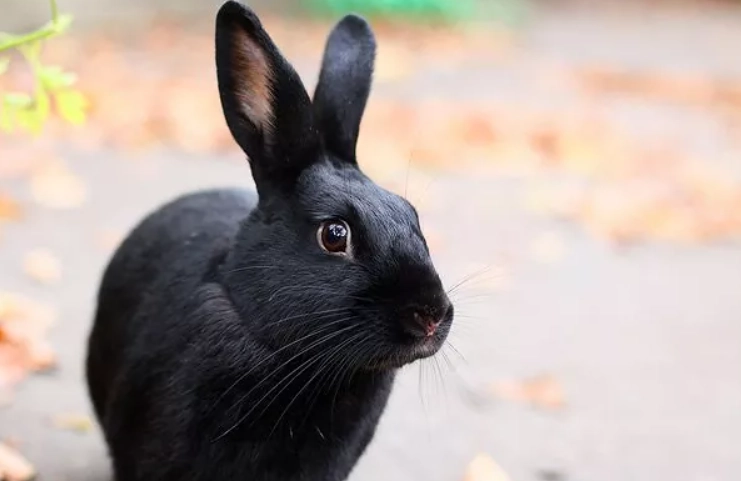
- The Manx Cat: The undisputed champion for the "cabbit" look. Seek a reputable breeder who tests for the associated spinal health issues. Be prepared for a cat with a powerful personality and that distinctive, hopping run.
- The American Bobtail: Has a short, "bobbed" tail that's often straight or slightly curved. Less extreme than the Manx's total lack, but still gives a truncated, bunny-like silhouette. They tend to be friendly and dog-like.
- A Munchkin Mix: Munchkins have short legs. If mixed with a breed that has less tail, the proportions can appear even more unusual. Note: The ethics of breeding Munchkins are debated due to potential joint problems.
- A Domestic Shorthair with the Right Look: Don't underestimate your local shelter! Sometimes a random-bred cat will have a natural bobtail or an agouti coat. You might just find your perfect "cabbit-esque" companion without any breeding at all. This is my personal favorite option—adoption first.
- Consider a Rabbit: Hear me out. If the appeal is the softness, the quietness, and the unique companionship, a rabbit itself is a wonderful pet. They can be litter-trained, are very clean, and have big personalities. They're not low-maintenance, though—they need space, specific diets, and vet care from an exotics specialist.
Your Burning Questions Answered (FAQ)
Wrapping It Up: The Final Verdict on the Cat/ Rabbit Hybrid
Let's be clear one last time: the idea of a cat/rabbit hybrid being real is pure fiction. It's a biological impossibility. But the reasons behind the myth—the unique Manx cats, the power of internet storytelling, our love for unusual pets—are fascinating in their own right.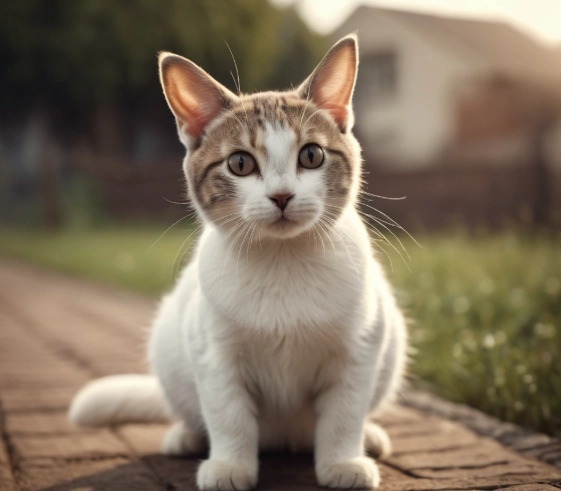
If you're captivated by the look of a "cabbit," your best bet is to seek out a Manx or an American Bobtail from a responsible breeder who prioritizes health. Better yet, visit your local animal shelter. You might just find a short-tailed, big-eyed cat who needs a home and will give you all the unique charm you're looking for, without the mythical pedigree.
The truth is, real animals are amazing enough. They don't need to be hybrids to be special. The next time you see a "cabbit" video, you can appreciate it for what it is: a delightful cat with some rabbit-like traits, starring in a modern-day fairy tale. And now, you know the real story behind the myth.
Reader Comments